Last month the theme was "Into Darkness" and we were talking about getting my nocturnes on display there but sadly it wasn't possible due to other commitments on my part. This month, the theme is "Secrets, Enigmas & Puzzles". Expect to see a poet, a musician, a dance troupe, two visual artists, a contemporary almost sample-based classical composer and a jazz trio whle the founder/hostesss/mc performs a few songs in between acts. The venue is a synagogue and it happens to fall on Channukah, so although the evening itself is normally not a religious thing there will be a chance to witness one of the rituals which in itself should be fascinating to see - I have never set foot in a synagogue before! Entry is on a "pay what you can" basis and I'm fully expecting it to be a little bizarre, a little thought provoking, possibly at times a little annoying but almost certainly a bit of a giggle. I like secrets, so I'm definitely getting there this month albeit as a member of the audience rather than a participant.
Monday, 25 November 2013
This Thursday: Open Arts Café
Last month the theme was "Into Darkness" and we were talking about getting my nocturnes on display there but sadly it wasn't possible due to other commitments on my part. This month, the theme is "Secrets, Enigmas & Puzzles". Expect to see a poet, a musician, a dance troupe, two visual artists, a contemporary almost sample-based classical composer and a jazz trio whle the founder/hostesss/mc performs a few songs in between acts. The venue is a synagogue and it happens to fall on Channukah, so although the evening itself is normally not a religious thing there will be a chance to witness one of the rituals which in itself should be fascinating to see - I have never set foot in a synagogue before! Entry is on a "pay what you can" basis and I'm fully expecting it to be a little bizarre, a little thought provoking, possibly at times a little annoying but almost certainly a bit of a giggle. I like secrets, so I'm definitely getting there this month albeit as a member of the audience rather than a participant.
Friday, 15 November 2013
Margaret Parker - Midland Canal
I found this by chance whist wandering round the Your Paintings site - the archive on the BBC attempting to show every painting in public collections in the UK. I'm sorry to say I can find nothing about either the artist or the painting; there's a Margaret Parker in the States but judging by her exhibition dates and style I don't think its the same one. This painting, of the Midland Canal, is in the University of York and I think its magnificent. There are 5 more things by her on the same website. I'd be very grateful if anyone could tell me anything about her or point me in the direction of more of her work.
Thursday, 14 November 2013
CRW Nevinson - Leaving the future behind
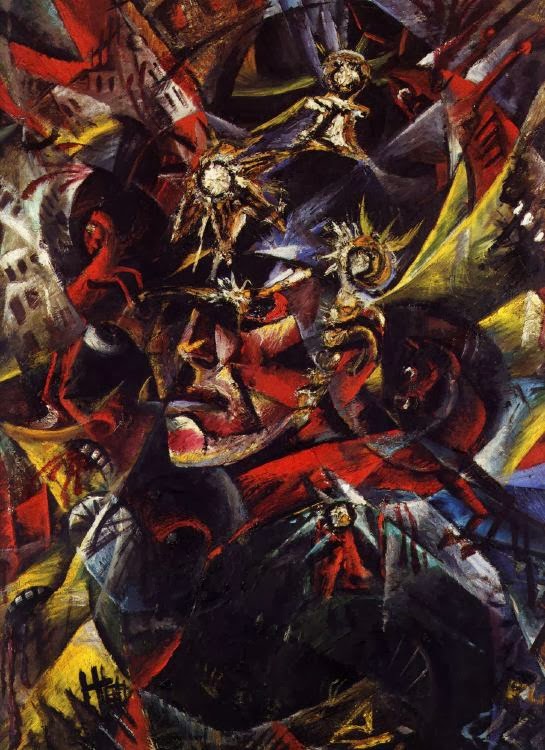
Born out of the mechanisation of Italy, very little compares to the aesthetic as a means of expressing the industrialised age. The Fascist politics associated with it are unacceptable to me, but that is not something to muse over now. In so far as it is possible to separate the images from the politics I intend to do so as Nevinson was a little apart from the rest, not least because he was in England, operating in a very different political environment from his Italian counterparts.
Futurism was founded by a poet, Marinetti, and extended to every aspect of Italian cultural life. I will point you to the assorted Futurist Manifestos so you can explore the scope. In the context of Nevinson, perhaps the key points from the original manifesto, published in Gazetta dell'Emilia almost exactly 104 years ago, are "we intend to sing the love of danger", "the world’s magnificence has been enriched by a new beauty: the beauty of speed", "No work without an aggressive character can be a masterpiece", "We will glorify war—the world’s only hygiene" and "We will sing of great crowds excited by work, by pleasure, and by riot". As the manifesto moves away from bullet points and back to rhetoric we come to a summation: "Art, in fact, can be nothing but violence, cruelty, and injustice."One particularly interesting aspect for me is the relationship of the movement to history. It was officially anti-history, decrying the past and making prophecies that the Futurists themselves would be torn down ten years hence. Yet if you didn't know this and simply tried to draw a family tree of visual style there are clear linguistic links all the way back to Uccello - compare how the girders here are arranged on diagonals to delineate space and movement in the same way the dogs are used in Hunt in the Forest. The cranes and funnels have the same function as the trees and, blue sky apart, even the colours are related.
For me the most bewildering aspect of his work is that immediately after his brutalised war work, Nevinson could be found painting pastoral scenes and even gardens in a half futurist and half cubist style. In the 1980's you would assume it was a dose of post-modern irony, but being made in the 20's makes it far more intriguing. Was he painting using mannerisms from habit? Or did he deliberately take two contrary traditions (the English picturesque rural idyll and a painting language developed to explore violence, mechanisation and de-personalisation) and use the one to subvert the other? And if he was using one to subvert the other, which is the subverter and which the subverted? At first glance one would assume as a Futurist he was anti-tradition and trying to industrialise the scenes, but I get the impression from his work that, as with Nash and so many others, the First World War changed aspects of him beyond recognition. Maybe this is history and tradition mounting a counter-offensive. If so, after these equivocal initial skirmishes, tradition won. By the 1930's Nevinson was firmly in the British landscape tradition along with Nash, Sutherland, Ravilious et al, the fields with their hedgerows the only reminder of his previous angular aesthetic.
Tuesday, 12 November 2013
Coming soon: Christmas Art Fair, Windsor
I've finally had confirmation, I'm taking part in my first Art Fair.It's at the Harte & Garter Hotel in Windsor which is very close to the castle and is on Saturday 30 November and Sunday 1 December from 10 to 5. It looks like there'll be 17 of us, so expect a wide range of styles, subjects and prices.
To be absolutely honest I'd prefer to be outside in the middle of the high street but at least this way I won't be telling you about a last minute cancellation due to the wind...
I'm expecting prices to start about £75 so there will be things well and truly within Christmas present money. £75 doesn't get much that is present-worthy these days - a good pair of jeans, a modest bottle of Chanel, a so-called "limited edition" Xbox game in presentation packaging. Even kids' toys can cost more than that. Nice things like jewellery and watches and weekends away and spa sessions and technology cost so much more. And yet, and yet, and yet, for the price of a massage at Champney's or a cigar and a bottle of whisky you can buy a unique thing, an original work of art which could give your loved ones pleasure every day for the rest of their life.
I haven't decided for sure what I'll take. I'm going through that process now but I will have a wintry theme including prints and oil paintings and, depending on my final selection, my prices will range from £75 to £400, £500 or £600. As an added bonus and to make your gift perfect, if you don't like a piece's frame, there will be plenty of time for me to replace it before Christmas too at no charge for a frame of equivalent value or at a well below the high street price for a more expensive one.
I hope to see you there.
Monday, 11 November 2013
Armistice Day: Otto Dix self-portraits
Whilst looking for paintings for yesterday and today, I was struck by the difference between the attitudes of the British and the Germans towards war art. In the UK in 1914, art was far less adventurous than the rest of Europe; the avant garde had not really leapt across the channel and yet the government, on entering the war, commissioned artists galore including the most modern we had. They were given relatively free reign and it seems to me that the challenges of depicting the war is what finally brought the new styles of art like cubism, futurism, surrealism and the rest to this country. In Germany by contrast there were already bold artists doing interesting things. Berlin may not have been Paris, but there was far more going on there than London. When it came to war art though, I have only been able to find one official German artist from the Great War, and he was as traditional as they come. It seems as though the power of art was ignored and that the Kaiser's government must have been just as aesthetically conservative as the Nazis were later on, when avant garde artists were shunned, shamed and chased into exile. Through the midst of this neglect and hostility from his government strode Otto Dix.
Dix served throughout the First World War and was decorated and, like so many others, deeply affected. If his work was sharp and cynical beforehand, it was doubly so afterwards. As an artist he was formally restless, trying many different styles and constantly evolving through his life and yet his subject - sharp, cynical observation of people and society - was constant through war and peace. Harsh is probably the best word.
With all this in mind, here we have two self portraits.
On the left, from early in his service and probably about the time Dix became an officer in charge of a machine gun, we have Self Portrait as Mars or Self Portrait as the God of War. On the right, painted after his release from a French POW came at the end of the Second World War, we have Self Portrait as a Prisoner of War. Put together they say more than words ever could; a journey from an angry young man just given the power to cause death on an industrial scale and affected who knows how (maybe even intoxicated by it at the beginning) to a weary, phlegmatic old man who looks as though he is no longer capable of feeling anything but fatigue. Individually they are hugely powerful pieces. Working together, they are a very human story of the path, effects and futility of war.
Subscribe to:
Posts (Atom)