Showing posts with label Runnymede. Show all posts

Tuesday, 7 April 2015

Coming this June: Runnymede Ghost

This summer, the world is coming to Runnymede and I'll be here to welcome everyone.

The tale of how Magna Carta was signed here has been told many times already this year, and it will be told even more over the next two months. This is because this strange treaty which has become one of the most famous and influential documents in the history of Western civilisation is about to be 800 years old.

There are huge celebrations surrounding the anniversary with events taking place worldwide. I am delighted to say that as the contemporary painter perhaps most local to the site of the signing of the treaty I am taking part and holding an exhibition to coincide with festivities in conjunction with Royal Holloway, University of London.


Both of these are essentially medieval views
The initial brief was simple - celebrate the landscape of Magna Carta - but the work has become far richer and I will be presenting a series of paintings which show the landscape as it is today in all its complexity and variety but highlight how easy it is to imagine how it looked at different times in the past including 800 years ago. The title, Runnymede Ghosts, simply draws attention to the way one can see the past through the present. Making the work has revealed a subtle and complex story which is as much about the environment as it is about history and has revealed Runnymede as ancient, fragile, resilient and above all man-made.

The thing I want to talk about is the final painting, which really ought to be well advanced already. All the prep work was done and I was just waiting for the bluebells to come out so I could finalise my palette when my subject was hit with some unexpected drama. There has been an encampment of protestors in the woods above Runnymede for the last two or three years. They initially tried to resurrect the spirit of the Diggers and have styled themselves more recently as an eco-village. My original plan was to show one particular part of the camp where there are still signs that the top of the hill was once parkland. The old, broken fence was to wend its way and guide the eye through the painting.


Over the last week or two, the landowners have given the protestors a writ to attend court with a view to eviction and have started to repair the boundaries. I'm waiting to see how it pans out before starting the painting. It has had a dramatic impact visually and is also interesting in the context of Magna Carta. The protestors' spokesman suggests this is a Magna Carta issue - he sees the court action as an act of oppression. I want to play Devil's advocate here. Magna Carta came about in part because the King was out of control and was seizing land from the nobility whenever he felt like it so the Barons made it clear that the law could be used to hold him to account. The protestors saw some land and they didn't like the way the owner wasn't using it so they seized it. The landowner is now trying to demonstrate to them that they are not above the law. So which side of this conflict is in the King's role and which in the Barons'? It is a Magna Carta issue, but not the way the protestors claim. Magna Carta enables landowners to evict people because it reinforces the status of law. I don't know how all this will creep into the painting yet but I find it interesting - just as the paintings reveal that the difference between good and bad environmentally is complex, blurred and often counterintuitive, so the eviction shows that the same can be said of issues relating to liberties and rights.

Realistically the fence and eviction are too complex for one painting so for the Ghosts series I will almost certainly stick to my original composition but using the half-built new fence in the same way as the old one. I will try retain BBC levels of neutrality as I haven't decided where I stand yet. It does tell me I'm on the right track though - if my work wasn't changing my opinions and challenging my preconceptions then to my mind I'd just be making pictures not art.

Monday, 23 February 2015

A quick catch up

It's been a busy old year since I was last updating this blog regularly. I've had do some bits away from art (seeing as how I like food and not sleeping outside) and I've done lots of little bits which I won't recap, but mostly I have been tied up with three substantial projects - two of which are ongoing.

About a year ago, I saw a call out from Obsidian for work relating to poetry. I'd been umming and aahing about working in this direction and had done a fair bit of preparation but it was the final wake up I needed to actually start. The first piece wasn't ready in time for the deadline but I have the beginnings of a major body of work now. So far, there are only four paintings but they are substantial, subtle and ambitious. Each addresses an old, short Japanese poem. Each poem was chosen after assessing as many English translations as I can get my hands on and avidly studying any notes the translators gave. The poem was then transplanted into 21st century southern England (I can't really paint from the view of an 8th century Japanese monk with any integrity!) and the painting then forms a meditation on that poem. The process helps me understand the poem better than I could otherwise hope to, and at the end I am left with a painting as full of richness and ambiguities as the original text.

Because fog engulfs/ the cottage where I am/ I feel as though/ I've melted into the sky. (Myoe  d. 1232)
The two main challenges with this poem were that the translation needed "vernacularising" as the peasants of England no longer live in grass huts and what it is to be in the sky needed rethinking - Myoe was writing in a time of birds, kites and Chinese lanterns and so to be airborne was to float and hang whereas today it is to zoom. Early morning mist over the river provided the solution to getting the sense of both flight and stillness necessary. 

I chose Japanese poems because they tend to be very visual and very intense whereas European, Classical and English poems tends to have more of a narrative element which would lead to more of a temptation to just illustrate them. This project is currently bubbling away on the back burner while I deal with more urgent things but I will be starting up again as soon as I have broken the back of my upcoming exhibition as the penny has recently dropped about the underlying meaning of Basho's famous frog haiku.

A lot of the late summer was spent as Artist in Residence at Sulgrave Manor in Northamptonshire. Built by the ancestors of George Washington, it is a modest Tudor manor full of Tudor furniture and I was privileged enough to be given fantastic access to it. Seeing as today the Manor places a large emphasis on making the past come alive, I looked for ways I could do that visually. In the end, I used it as a vehicle to explore the absence of electric light - what the mind does to shadows and sound when there is no way to make darkness disappear and trying to imagine what darkness might have been to people who would not have had any conception of electric light. This had the added bonus of picking up on discoveries from my work with nocturnes. There was a real temptation to build nightmares into the shadows, but I resisted and played it straight. Anything you see in them is what is already in your own mind.

Since then I have been working towards a short but major exhibition this summer. As readers from before may remember, I work on the edge of Runnymede, the water meadows where Magna Carta was signed. This June sees the 800th anniversary of the Charter and there are a lot of events locally, nationally and globally. I am taking part in the celebrations being held at Egham by Royal Holloway, University of London. The central idea is to show parts of Runnymede which make it easy to imagine how the place looked in the past. I have previewed two paintings on my website, the rest will be launched just before the exhibition. There will be more about this over the coming months, but for now here are the dates - 12 - 16 June, with the University's Great Charter festival being held on Sunday 14 June. 

Old overgrown ditch at Ankerwycke. Uniquely among this set, this painting is stagnant and time weighs heavy.

Monday, 20 January 2014

Frost

I don't know what it is about this place, but I never lose my sense of wonder here and no matter how many times I walk the same mile-long circuit, it always feels like I'm seeing something new. On reflection, I think I like it best with a coating of frost.


 Incidentally, spring isn't far away now.


Wednesday, 8 January 2014

Runnymede in Flood: The definition of "Water-Meadow"

Went wandering before dawn yesterday...


Its got a lot floodier since, so much so that I don't want to blunder along the riverbank in anything other than broad daylight...


Incidentally, I've decided Blogger (this blog's host) sucks when it comes to showing pictures - in order to get the before dawn pictures up without really bizarre things happening to the colours I've had to sign up to things I don't want to sign up to. As a result, I'm considering this blog's future. I can't afford, when it comes to paintings, for Google to be changing colours when it feels like it. The fact it is doing this may explain my frustration with the reproductions I've been able to post here. I think that I will most likely host the blog myself as part of my website but I have yet to decide. When I do, there will be clear links from the last post that I put here.

Wednesday, 4 December 2013

New Work: Cooper's Hill Coppice


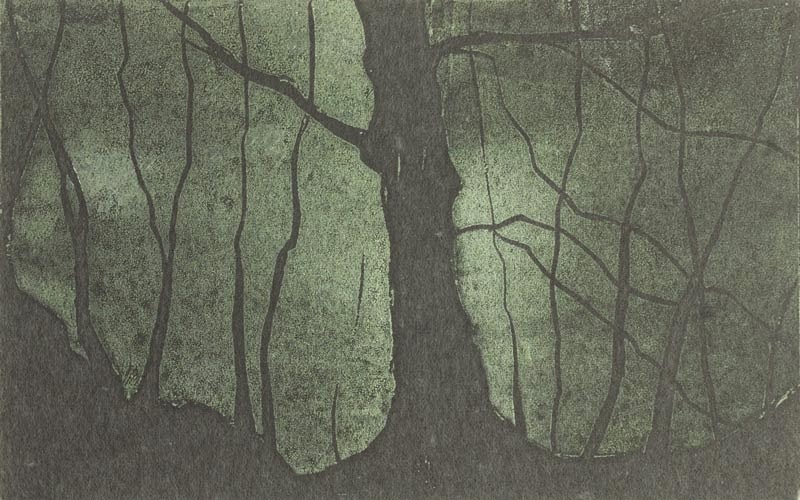
Bet you thought I'd abandoned the project! It has been a long time coming, but here we have the next two instalments from the series, July and August. The reason for the delay is that I have been pushing the medium until it screams and begs for mercy which has led to a fair bit of failure. These two don't push the envelope in terms of carving but they do in terms of printing and the way I'm using paper.

The first one, July, involves four processes which range from princess-and-the-pea delicacy to barely controlled violence. The key to the process is changing the texture of the paper part of the way through printing. Finding a paper that did everything I wanted took 6 weeks and is the main reason for the delay.

The second one goes to the other extreme. When I was picking out the paper and I asked whether I'd get away with it for block printing, the look on the man from Atlantis' face was a picture. Why? I hear you ask. Well, the thickness of paper is measured in terms of weight. For context, watercolour paper typically ranges from 160-600 grams per square metre. Typical drawing paper will range from 100-200 gsm. Photocopy paper might be 80 gsm. Tissue paper is often around 20 gsm. The paper I have used is 9 gsm. It's a Japanese hemp based tissue and if you breathe heavily it floats away. The reason I wanted it was its transparency and smoothness. In this edition I have printed the green canopy, mucking about with the inks to give a hint of texture. I have then mounted it so it floats above a dark brown backing to give the rest of the colour. Perhaps it is a little too eerie for August, but it has so much atmosphere I didn't want to change it.

Monday, 21 October 2013


Right click and choose open in new window. It'll all be orange soon...

Thursday, 17 October 2013

New Work: Nocturnes

Its time to call a temporary halt to my beautiful nightmare: considering the term nocturne's musical heritage perhaps I shall call it an interval.

I have loved making these, I think I could work on more for many months yet to come. They are strange - easy on the hands but incredibly difficult on the judgement. The hand and brush skills required are minimal but the everything else is demanding. When you are working within such a tiny tonal range then the way every mark catches the light, the sharpness or softness of every edge, the tiny differences in colour, the opacity and transparency of every glaze or impasto, the relative glossiness of each passage, the way the texture of the canvas is emphasised or disguised and a thousand other subtleties take on a disproportionate importance because they are the only way the space, the light and the looming quality of the landscape can be indicated. They are the hardest things I have done, and I am a better painter for having made them.

So far there are six. Two show the full moon in relation to the bushes that grow along the riverbank here, the square one barely shows the Thames itself reflecting back the inky sky. All of these three are dominated by the street lamps of either the M25 or Englefield Green which, although they are out of sight, are close enough to stain the sky near the horizon as if with a permanent, artificial sunset. The other three explore the impact of car headlights. In one they are blinding, in another they slash the world in half but at the same time help give form to it and in the third they are less dominant and give glimpses of the surrounding trees.

There are two larger ones yet to be started related to these, and three more which are just a gleam in my eye at this stage which will look at the way mist rises across the meadow. I'll freshen up with something else a little more autumnal before I make those though.


I know you must be sick of me bemoaning the difference between a painting and a photograph of that painting, especially given my tendency to build paintings from multiple layers of transparent paint, but never has it been truer than here. The plan is to show them in Guildford in January; coming and seeing them is the only way to understand the subtlety. I may put close-ups up here at some point to give you a chance, but I've gone on enough for one day!

Tuesday, 8 October 2013

Heatwave!

Well, summer has well and truly kicked back into life on the mead recently. By October standards, we are in a positive heatwave and shorts are the order of the day. It looks like today will be the last of it, but hey, its been nice. Pleasant temperatures + early autumn colours + loads of apples and nuts = happy Alan.


The night time pictures are almost done (well, apart from a batch of bigger ones I haven't even started...) so in a few days time I'll be able to dive heart first into the foliage. I've got a more cerebral/playful autumn project well into planning but I won't be able to do any actual painting for that for a while, so I think its time for simple, joyous colour sketches for the art fairs I'm getting involved in.

Wednesday, 25 September 2013

A what if about Whistler

I was coming home last night and cut across the meadow. The moon was rising and so was a mist so I nipped back out again with my camera; I'm really enjoying grappling with my own Nocturnes so the more raw material the better. The mist did beautiful things to the street lamps and headlights on the bypass in the first photo and conjured light seemingly out of nowhere across the whole width of the meadow in the second - the light on the right is from the entrance to the duty free warehouse and the light on the left is from the bypass and even though they are hundreds of metres apart the mist has managed to draw them together. The light on the horizon is a house just on the brow of the hill.


I can't help but wonder what Whistler would have made of modern digital cameras and the ability to capture fleeting effects of colour and light so effortlessly. Would he just revel in the joy of it and lose his discipline? Would he be frustrated at the limitations of the kit and the distortions in colour, shape and space photography inevitably introduces? Would it just be a way to gather information for paintings, a companion to the sketchbook and a prompt to the memory? Or would he find a way to elevate the medium to new heights? Of course there's no knowing and the same questions could and should be asked about Monet and Degas and many others, but speculating about it is an intriguing way to while away five minutes.

Sunday, 15 September 2013

I've really struggled to settle down after the disruption of recent weeks but I've been out walking again and I'm beginning to think a little clearer; I think I know what's going to happen next and that's a big thing, I've been a bit directionless since I pulled everything together for the show.

The key thing is that the season is beginning to turn. Regulars here will have seen how over-excited I was about spring and that the frequency of my reports about the meadow and woods dropped dramatically when summer hit. The simple reason is the day to day changes got too subtle for me but now, well now we're heading into another time of year when the world is different every single day, as if it gets made afresh every night.


Click on the picture to make it big and you'll notice there is a lot of variation in the colour of trees now when there wasn't a couple of months ago. Round here, the Horse Chestnuts are the first to change to yellow and brown as they are plagued with fungal infections in their leaves but the other trees won't be far behind.


As an aside, the skies are still epic but there won't be many more of the soft and endless skies of summer like there was this morning; if you think the spring skies were dramatic, wait until autumn lets rip! I've been wondering and asking other people why Runnymede's skies get so spectacular; the best guess is that, although Cooper's Hill is only low and is 20 miles inland of the Thames Barrier, it's the first steep hill any wind coming up the Thames Estuary meets and that must do funny things to the air currents, which will be damp and cloudy from the North Sea or cold and dry from a trek over Northern Europe. Doesn't really matter though; when the fireworks are good who cares how they make the gunpowder!

Sunday, 1 September 2013

Between the devil and the deep blue sky


I've been saying it for months now, and I suspect I'll keep saying it for as long as I'm around Runnymede, but if I painted half the skies I see here, no-one would believe me!

Tuesday, 20 August 2013

Summer by the river and the living is easy...

Well, it's properly here. My harsh little water-meadow has emerged from the floods and the frosts, blossomed, bloomed and grown, dried, and now, finally, begun to ripen. We are into 6 - 8 weeks of abundance. In fact, my favourite type of blackberries hit their peak last week and are fading already but there are plenty of others still growing. The elderberries are turning dark, the sunniest sloes need just a night in the freezer to make them right and the plums are perhaps a week or two away. The second-best apple tree is more than ripe enough now, the apples sweet enough to be nice but still sharp enough to fizz on your tongue. The best one isn't far behind.


I've done a grand tour of the nut trees. The squirrels, greedy little short-sighted thingummies that they are, are attacking the hazelnuts before they're ripe so I don't know whether I'll get many or not. I don't know about chestnuts yet as the trees are too tall, but it looks like it'll be an outrageous year for walnuts. Not only is every tree full, but I'm finding more trees all the time.


This time of year sees me on more of a caveman diet, with berries now and nuts later forming a large part of my meals. I lose weight but gain health. I would have to say that harvest time is one of my favourite times of year, right up there with winter, spring, autumn and early summer.

Tuesday, 23 July 2013

Dark

It was full moon a day or two ago and the sky was hazy but cloudless. I've been waiting for this so stumbled out across the fields.

Last full moon there was patchy cloud to soften the world but this time, with no clouds to help, the world was harsh, strange and simple.


By midnight the only colour in the sky was from distant towns and the motorway.

The quality isn't great in these pictures as I was using the camera as a sketchbook rather than taking photographs for their own sake - you can't even draw when its that dark. I was more interested in the level of darkness I could see, the remnants of colour I could see and recording the exact amount of missing detail so the camera was howling about the amount of light I was letting it see which is why there's so much noise. I've been kind to you and made everything lighter than the files I'll be working from otherwise you wouldn't see a thing unless you turned out the lights.

You can see why midnight is sometimes called the witching hour. While I was walking I saw the way this one bare tree clawed at the moon. It set me thinking about the old moonraker story - a fool lived in a village and saw the reflection of the moon in a pond and tried to fish it out using a rake. Old myths and stories still live in the landscape - all you have to do is look.

Wednesday, 17 July 2013

New Work: Quercus Quercus

By now, any regulars here will know Cooper's Hill and the woods that blanket it. You've seen photos, paintings and linocuts. There's a path that runs along the bottom edge of the woods from the Ferrari garage past Mudward to the wizened tree in the April linocut before bursting out of the end of the woods and continuing on to the Runnymede Memorial. Partway along the path, if you care to look over your left shoulder, you will see two magnificent oak trees interweaving without ever touching. This linocut is a study of their winter silhouette.


It is an edition of 30 on Japanese-style washi. The printed area is about 13.5cm wide x 16cm high. I've varied pressure to leave the branches more lightly printed and the core of the trees darker and stronger.

As I'm prone to doing, I have taken a slight liberty with the title. Strictly speaking the trees are called quercus robur, commonly known as the English, French or Pedunculate Oak. If, however, one goes another level up through the taxonomy of plants, it is in the quercus section of the quercus genus (that basically means its in the white oak group of oak trees - you learn something every week here!) so although no-one would really call it quercus quercus if you stretch a point it kind of is. I wanted to call it that though because, just as two identical words come together to form one name, so two very similar trees come together to form one silhouette - indeed in summer they look like one tree with two trunks.

This is just step one on the path to something I find very exciting based on two observations - 1: it is so difficult to work out which branch belongs to which tree I might as well choose for myself and 2: one tree appears more masculine, the other more feminine. This is the final stage of my prep work except I need to change medium, find a different printing technique or work far bigger - any time I tried to shave the branches finer the lino started to crumble.

Wednesday, 3 July 2013

A temporal landmark

As you know, I've been thinking a lot about landmarks over the last couple of months and I've also begun to think about time. Well, current events have made realise that there is a certain type of landmark that doesn't just tell you where you are, it tells you when you are as well.

From my posts here, you could be forgiven for thinking Runnymede to be a timeless pocket of nature which ebbs and flows with the seasons but fundamentally stays the same and to a degree you would be right. Ultimately however it is not a natural environment but a collaboration between man and nature that has developed over two millennia or more. As with anything managed by man, there are occasional, sudden changes and there have been two such changes this week.

Firstly, the first crop of hay of the year has been cut, left for a couple of days to start to dry, baled and taken in. Second, the fairground has arrived.


Seeing the hay being cut tells you that from a weather point of view, given the particular spring we had this year, it is midsummer. The fair turning up, in Egham at least, means its around about midsummer from a calendar point of view as well. The fair gives an extra level of precision - is it open? are people coming or going? are the lights in the caravans on? The hay gives us extra information too - the farmer thinks the weather is going to be fine for a few days.

A particular hay meadow isn't distinctive unless it is in isolation; its hedges may be but the grass isn't at first glance. I wonder if its a landmark at all, or if its actually a timemark.

Wednesday, 26 June 2013

What lies beneath? A real-world mystery

Here we have an idyllic English woodland. But what happens if we follow the path?


A woman's clothes. Tops. A pair of neatly folded jeans.


A black scarf. A sweater and a jar.


A belt and some fabric trimming.


A brush and some jars of spices.


A box of candles, some rope, cutlery and a sewing kit. I don't know what's going on. I do know it happened a while ago - I saw these at the tail end of winter (in fact, they're only just out of view in one of my paintings) and thought they'd make much better photographs with plants growing up, round and through them but the mystery remains the same. She is either a camper (there is a protest camp nearby) or a student (there are halls of residence at the top of the hill). She must have been going somewhere, not coming back - the jeans and the clothes in the tree roots were clean and folded when I first saw them. It seems strange she would throw away a scarf and a sweater in the middle of winter. Did she drop out of university and throw everything away in a glorious moment of joy? Did a fellow student play a prank and hide all her things at the beginning of term, only to forget where? Did a thief pause here to rifle through the bag he stole? Or is something darker also hidden here? The possessions are strewn in a trail up to the edge of a very steep slope; I didn't follow further. When I first found them I had a genuine moment of doubt - should I phone the police? I still don't know, but I've not heard of anyone having gone missing. It's too late to lose sleep over it, but stumbling onto the same site again today makes me wonder what happened all over again.